Showing posts with label Vogue. Show all posts

Wednesday, 19 February 2014

Birthday dress

This is a pattern I've been wanting to sew up for some time, and after making a few ponte dresses recently, I realised this would also work well. I didn't have a huge amount of time to make a dress for my birthday, so it occurred to me that this would be a good time to try it out - ponte dresses are a little more forgiving of fit so I tend not to muslin them, which would save time.

Pattern description

Vogue 8667: Lined, princess seamed dress with fitted bodice, A-line or straight skirt and back zip. Options of cap sleeves and bias-cut collar.

Pattern sizing

8-24. I cut the 16 at the bust, grading out to 18 at waist and hip. I'm glad I checked the finished measurements on the pattern pieces - it is described as a "fitted bodice", but has 3 inches of ease at both bust and waist, which seems like an awful lot (especially given I was making this in a stretch fabric). I cut it a size smaller than would be indicated by the size chart.

Fabric used

Printed ponte from Fabric.com

Did it look like the photo/drawing on the pattern envelope when you were done?

Yep.

Were the instructions easy to follow?

I didn't look at the instructions much, but I did do a read-through and they were mostly ok. I did have a couple of quibbles though from what I saw though, one more minor and one a bit bigger... For all Burda's terrible instructions, at least they do normally tell you which side to press the seam towards. I was following the pictures in the instructions here and pressed the princess seams in the bodice towards the side pieces. It was only after I'd graded them and couldn't get them to lie nicely that I realised in the following pictures they were shown pressed open. Duh. And sort of annoying as I didn't need to grade them so much if I'd pressed it correctly.

The other issue I had was with the insertion of the lining. Although I didn't line this dress I did look at the instructions for future reference. The way they suggest to the lining is inserted in sections is really bizarre, meaning you would end up with exposed seams at the armscyes and a really ugly looking zip. I don't quite understand why they wouldn't suggest the lining was made up completely separately and inserted after the zip was put in.

What did you particularly like or dislike about the pattern?

Likes: The drafting is nice and all the style lines flow nicely from bodice to skirt. I really like the pleats at the front of the skirt, I think they are very flattering - as is the neckline.

Dislikes: As already mentioned the method of inserting the lining is bizarre. For my preferences, there is also too much ease as drafted.

Pattern alterations or any design changes you made

I made an FBA, rotated the back shoulder and neckline down to adjust for swayback, took in the back slightly at the waist, and made my usual forward shoulder adjustment to the armscye and sleeve head. I omitted the zip given I was making the dress in ponte, and therefore cut the centre back bodice on a fold. I decided not to line the dress as I would be wearing it with a slip (and I don't much like knit linings).

Construction details

As this dress involved a bit of easing in the princess seams and the sleeve caps (and the fabric doesn't fray or ravel), I constructed it all on my regular sewing machine, using a very narrow zig-zag stitch (avoiding the serger was also for ease of unpicking in case of adjustment, as I didn't want to make a muslin). To be honest, it probably would have been better to make it on the serger (or at least finish the seams on the serger), as this would have looked much neater on the inside. As it is, it's u-g-l-y on the inside. Oh well.

I finished the neckline with bias strip facing, topstitched down, and also finished the armscye seams with bias tape as they just looked way too ugly to be left unfinished. The shoulder seams were reinforced with grosgrain tape. I found that the sleeves and the hem were exactly the right length before finishing, so I finished these with stretch lace and bias tape facings respectively. The bias tape on the hem is reasonably heavyweight, so it also gives the hem a nice bit of structure. I used the "wrong" side of the lace on the sleeves as it is smoother.

Would you sew it again? Would you recommend it to others?

I may well sew this again as I do like the fit and the shape (although the fit over my bust needs a bit of work), and I would like to try the collar. I will probably make it in a woven, with lining, if I do make it again. I would definitely recommend this to others - it is quick to sew and is a very flattering dress.

Conclusion

I really enjoyed wearing this for dinner and drinks with friends, and got a lot of compliments on it. I might try to adjust the fit over the bust a little before I wear it again though - whilst it's fine when I'm standing or sitting up with good posture, it looks a bit odd and wrinkly when I lean forward or slouch... (Just don't slouch then?). I love this print and colour, and the fabric is super comfortable to wear. All in all, a pretty successful make.

Sunday, 31 March 2013

Summer shirt dress

More sewing for the holiday! And for summer in general... I've been trying to use some more of my patterns - this is one I bought fairly recently. Apologies that I am not modelling any of the clothes in the next few posts, I didn't have time for a photoshoot in the last couple of weeks, and now they are all folded up and packed for holiday... I will post photos of them "in use" when I'm back!

Pattern description

Vogue 8613: close fitting dress with front yoke, three bust darts, collar, cap sleeves and slightly flared skirt.

Pattern sizing

Available in sizes 8-24. I cut the 16.

Fabric used

Stretch rayon challis, with non-stretch rayon challis for the collar and facings.

Did it look like the photo/drawing on the pattern envelope/sketch/idea when you were done?

Not entirely. As many have noted on Pattern Review, this is actually much closer fitting than the picture on the front would lead you to believe. I was concerned that I'd misread or mismeasured something, but checking the garment measurements printed on the pattern confirmed that it really is very close fitting. It is very low cut at the front (even for me - and I like fairly low cut tops!), so I raised the top button about 2cm (and re-spaced the buttons accordingly). If I made this again, I would alter the shape of the front piece slightly so that the lapel curves out only above the top button.

I also really don't like zips in stretchy garments if they can be avoided (and I knew that with this particular fabric it would be a nightmare to put in neatly), so I extended the centre front so that the buttons continue into the skirt. I would imagine that if this was made in a jersey, the zip could easily be eliminated without extending the buttons to the skirt.

Were the instructions easy to follow?

They were mostly pretty good. The only part I got a bit confused about was the collar, I had to read it through a few times to work it out. Other than that it's pretty straightforward.

What did you particularly like or dislike about the pattern?

I like the front yoke and interesting bust dart placement, and jersey dresses are always useful in anyone's wardrobe! I really didn't like how much ease there is in the sleeve caps: 4cm!!! In a dress drafted for knits!!! I couldn't get the sleeves in as intended without some puckering, so decided to fold out the excess to create a small pleat at the top of the sleeve. I actually quite like how this looks.

Pattern alterations or any design changes you made

As already mentioned, I extended the buttons all the way down the front, extending the centre front of the skirt by the same amount as the bodice, and adding a facing. If I'd thought about it earlier (and had had enough fabric) I would have cut the facings as one (i.e. without a seam at the waistline). I added a fair amount at the waist seams, but it fitted well enough elsewhere, even without my usual FBA. (It would fit better with an FBA, but I couldn't be bothered working it out here. I will probably do so if I make another one.)

Construction details

I serged all exposed seams. Enclosed seams were sewn on my regular machine and pinked (i.e. where the facings were joined to the front edges, and where the collar was attached). I did much more topstitching than the pattern indicates, as I liked the look of it.

I used cotton batiste to interface the collar and the facings. The collar has actually ended up a little bulky, but I don't know how I would avoid that. I also added elastic at the waistline, serging it on as I sewed the seam. My fabric is pretty heavy, so this provides some support for the weight of the skirt.

I added a hook and thread bar at the waistline.

Would you sew it again? Would you recommend it to others?

I might sew this again - I quite like the idea of it in a plain fabric. However, repeats of most things generally take a low priority for me, so I think I will give it a few wears to see how much I like it before deciding.

I would recommend this to others, but be aware that it is actually very close fitting.

Conclusion

When I finished this dress, I was rather down on it, as it wasn't particularly fun to sew - the fabrics I chose were slippery and stretchy and blah. I'm not super happy with the finishing on this dress, but after leaving it a few days I don't think it looks quite as sloppy and "home-made" as I first did. I'm not convinced the hem is totally ok, but I'm really not feeling like redoing it right at the moment. I am slightly in two minds whether it looks retro and funky, or just a bit frumpy, but I'm coming down on the side of funky and retro I think, as long as the styling is right. It is certainly very comfortable to wear, and is a lovely cool fabric for the summer.

Saturday, 9 February 2013

1950s birthday dress

It was my birthday this week, and I wanted to have a party - and what better theme than the 1950s? Especially as it meant I could make a lovely dress! And curl my hair! And wear red lipstick! However, this make turned into a bit of a saga...

Right, I have *ahem* six boxes of vintage patterns, so this was totally the perfect time to use one. I could make a fabulous genuine 50s cocktail dress! Hmm, except I have now discovered I actually have very few vintage cocktail dress patterns, and even fewer that are close enough to my size to be able to make quickly (oh yeah, I started on Saturday, needed the dress on Thursday). Hang on, what about this pattern:

Perfect! And pretty much in my size too! Although... I had my suspicions that this was actually 60s - there was something off about the bodice (and the hairstyle in the illustration), so it was off to Google and the Vintage Pattern Wiki to investigate. Hmm. 1962. Now I'm pretty sure none of my friends here are experts on mid-century dress styles, but I would know, and I knew I wouldn't be happy if I just made this as is. However, the skirt portion was perfect for a 50s style, so I figured I could just frankenpattern a different bodice onto it. I had a browse through my Sears catalogue book, and figured the thing to have was a simple close-fitting bodice with kimono sleeves. This picture became my inspiration (the black dress in the middle):

I then had another brainwave - how about using one of the patterns from my lovely new Gertie book? She has a pattern for a very fitted "wiggle" dress, with kimono sleeves that have gussets to reduce that flappy bit of fabric between armpit and shoulder, which, as a more well endowed lady, has always been my bugbear with cut-on sleeves. Marvellous. Except... I have to say now I've had a go at sewing something from this book, I'm a little disappointed. I totally love everything about Gertie, and feel awful criticising her beautiful book, but there were just so many niggles: issues with the drafting (various seams didn't quite match up, including, rather importantly, when inserting the gussets), there is no waist line marked on the patterns, the instructions have parts that are slightly ambiguous, and are made more ambiguous by the very pretty but rather unclear illustrations (rather than photos or technical illustrations) of the construction, there is a complete lack of technical drawings, and even little things like not being able to find an explicit statement of whether the seam allowances are included in the pattern pieces (I'm pretty certain they are, but it would be useful to actually say so). Sad. I attempted a muslin of the top part of the dress, but got so frustrated with the construction issues and the huge amounts of fitting that was needed that this got put aside (as in rather forcefully "put aside" into the bin...).

New day, new plan: use a bodice from another vintage pattern. I remembered this one:

A little small, but shouldn't be too hard to grade up a little, right? And maybe with the cap sleeves there wouldn't be so much issue with the excess fabric? Wrong and wrong. Waaaaay too small, and way too much flappiness.

Right, it was getting rather too close to Party Time for comfort by this stage, so I got down to it and decided to draft the damn bodice from scratch. I used my trusty Aldrich book, and drafted the basic close-fitting block, did the FBA, then transformed this into a close fitting kimono block with diamond gussets. Then turned over the page and realised they had instructions for a short-sleeved version with gusset inserts at the bottom of the sleeve which was just what I wanted. So a quick(ish) redraft later and I was making up a toile of a marvellous bodice! Hurrah! I did need to reduce the FBA a bit, but other than that there were only minor fitting corrections and changes to the style of the neckline to do. Phew. The make was finally on.

Pattern description

Close fitting dress with pencil skirt. Bodice is self drafted and has bateau neckline in front, low scoop neckline in back, and short kimono sleeves with gusset. Skirt is just past knee length, with draped front overskirt.

Pattern sizing

The bodice is drafted to my measurements, the skirt is (vintage) size 20.

Fabric used

Silk twill from Mood in New York! This fabric is so gorgeous. I actually think I'm in love with it. It doesn't really come across in the photos, but it's fairly beefy, is a sort of greenish gold colour and has a sort of hammered, crackly appearance. It is completely beautiful, and a dream to sew. All through the make I was just so happy because I could keep looking at and touching the fabric.

The lining is bog-standard taffeta lining, probably poly. It would have been lovely to line this in silk, but this is what I had in my stash.

Did it look like the photo/drawing on the pattern envelope/sketch/idea when you were done?

I'm glad I stuck with this dress, as it ended up pretty much like the vision I had of what I wanted. (Apologies for the slight wrinkliness of the dress in the photos here, they were taken the day after the party, and I obviously didn't re-press it very well!)

Were the instructions easy to follow?

Well, the only instructions I had were for the skirt portion as the top was self drafted. These were actually pretty good - it was late enough to be a printed pattern, so the markings were very clear, and the instructions were nicely illustrated which meant they were very easy to follow. The only issue I had was when sewing the side seam on the right, where the overskirt was attached: they have you sew it through the facing at the same time, but it would actually work better with the facing held out the way, then flapped back up, the seam allowance at the side turned under, and then slipstitched to the seam to hide the raw edges. I will actually unpick this seam and do this, along with a few other small finishing touches I didn't get time to do before the party.

What did you particularly like or dislike about the pattern?

I totally adore the draping on the skirt. It's super easy to sew (it's just three tucks that are basted then fixed by sewing into the waist seam), but looks so pretty (and is very flattering over the stomach). For the bodice, I'm very glad I ended up drafting it myself, as the fit is great. I'm also converted to underarm gussets (I still find that word hilarious) - they're actually pretty easy to sew and make such a difference to the fit.

Pattern alterations or any design changes you made/Drafting details

The skirt was pretty much sewn up out the envelope, with only a few minor changes: I pegged it by 4cm total at the side seams, and lengthened it by 4.5cm; I adjusted the position of the darts to match the bodice and lengthened the back darts by about 2.5cm; and I let out the waist a little.

The bodice was drafted using my high bust measurement, then an FBA done (although as I mentioned above I needed to reduce it after making the muslin). I then converted the basic block into a kimono block, and followed the exact instructions in the Aldrich book to draft a cap sleeve with a gusset.

Construction details

I wanted to keep this fairly true to vintage, so the construction is all done with my standard lockstich machine and the seam allowances are pinked. The silk twill actually hardly frays, so this works pretty well. The facings and zipper opening are interfaced with fusible interfacing, and the neckline on the shell is reinforced with Vilene bias tape.

The main construction challenge on this dress was the sleeve gussets. Although they seemed like an intimidating prospect at first, after practicing on the toile I found that with careful marking and a little concentration they're actually fairly straightforward to sew. Two blog posts were very helpful in working out how to do them: Gertie's post about the triangular gussets in her wiggle dress, and Karen's post about the gusset inserts in her retro Butterick rose dress. I used a combination of these two techniques - I will be writing another post explaining how I sewed the gussets as it has ended up as a pretty lengthy description (and I need to take some photos to illustrate the process).

I decided on a centre back zipper, and used a lapped insertion to keep with the vintage look. I used the method given in the Vogue Sewing Book for how to do this when there's a facing involved: basically you fold back the facing 2.5cm (1") on the overlapping side, sew the facings and understitch, then insert the zipper, meaning that the facing clears the zipper teeth when it's all finished. The overlapping side of the zipper is handpicked (have I mentioned how much I love hand-stitching?).

Walking ease in the skirt is given by the construction of a slit in the skirt on the right side, which is hidden by the overskirt. The hem is just turned up and held in place with catch-stitching.

The lining is constructed using the same pattern pieces as the bodice and skirt. For the bodice, I traced the pattern pieces, marked a 4.5cm wide neckline facing and cut along this line. I didn't sew the darts in the skirt lining right to the points to allow for a little ease and reduce strain on the lining when sitting. To allow for walking ease in the lining I left side slits on both sides and topstitched the seam allowances here. The lining was sewn to the shell at the neckline by machine, then slipstitched to the zipper tape and sleeve hem allowance by hand.

As this ended up being finished in rather a rush, so there are a few bits and pieces that were either missed off or need to be redone and tidied up:

  • Add a hook and thread bar to the top of the zipper.
  • Add an inner waist stay. I wasn't going to add this, but after wearing the dress it would actually be very useful for two reasons: supporting the weight of the drape on the front skirt, and keeping the bodice in place. I actually added a little too much length in the bodice after making a toile, which means it rides up a little, interfering with the fit of the shoulders.
  • Add lingerie guards to the shoulders to keep bra straps hidden and also help keep the shoulders sitting correctly.
  • Make the matching belt.
  • Unpick and resew the bottom of the side seam where the overskirt joins, so that the raw edges are hidden better.
  • Resew the lining to the shell at the sleeve hems - I did this in a rush, so some of the stitches show on the outside.
  • Tidy up some of the seam allowances that I ran out of time to finish.
  • Perhaps redo the hem with some lace to make it a little prettier.

Would you sew it again? Would you recommend it to others?

I doubt I will sew this exact dress again, but I am definitely going to be using gussets in kimono sleeves again. I love the look of cut-on sleeves, but hate the pooling of fabric at the front of the shoulder that is just hideous with any sort of larger than average bust, and very ugly in anything even semi-fitted. Using the gussets really keeps it fitted but still comfortable. I would definitely recommend others try using these, they're really not as intimidating as they first seem.

Conclusion

An outstanding success! I felt very glamourous wearing this, and the combination of fabric and pattern was perfect. For the party I paired it with a gold belt (as I didn't get time to sew the matching belt), vintage earrings from eBay, heels, and stocking with a seam. I then added later on the gorgeous necklace you can see in the photos, which was a birthday present.

And as for the party, that was also a success. I made punch, pineapple and cheese on sticks, devilled eggs, smoked salmon and avocado blinis, and pineapple upside down cake, and I even found some Coke in glass bottles. Everyone looked lovely, and I think a good time was had by all...

Thursday, 1 September 2011

Self-Stitched-September '11: Day 1, plus a new dress

So, September's come round quickly, and it's another me-made month! I think this month I will do periodic round-up posts on my blog, unless there is something particularly interesting that deserves its own post. And as this is the first day of the challenge, and it's a new dress, I figured this was one of those situations.

I'm not doing a full-on review for this, as it's the same pattern and very similarly constructed to the silk charmeuse wrap dress I've just made, but the differences are detailed below.

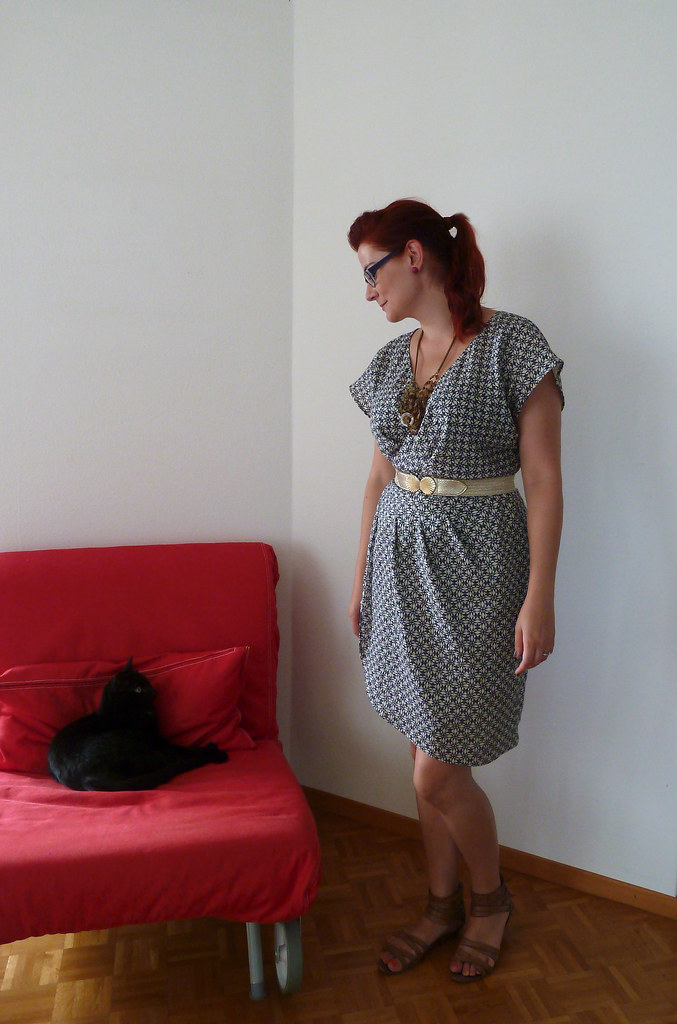
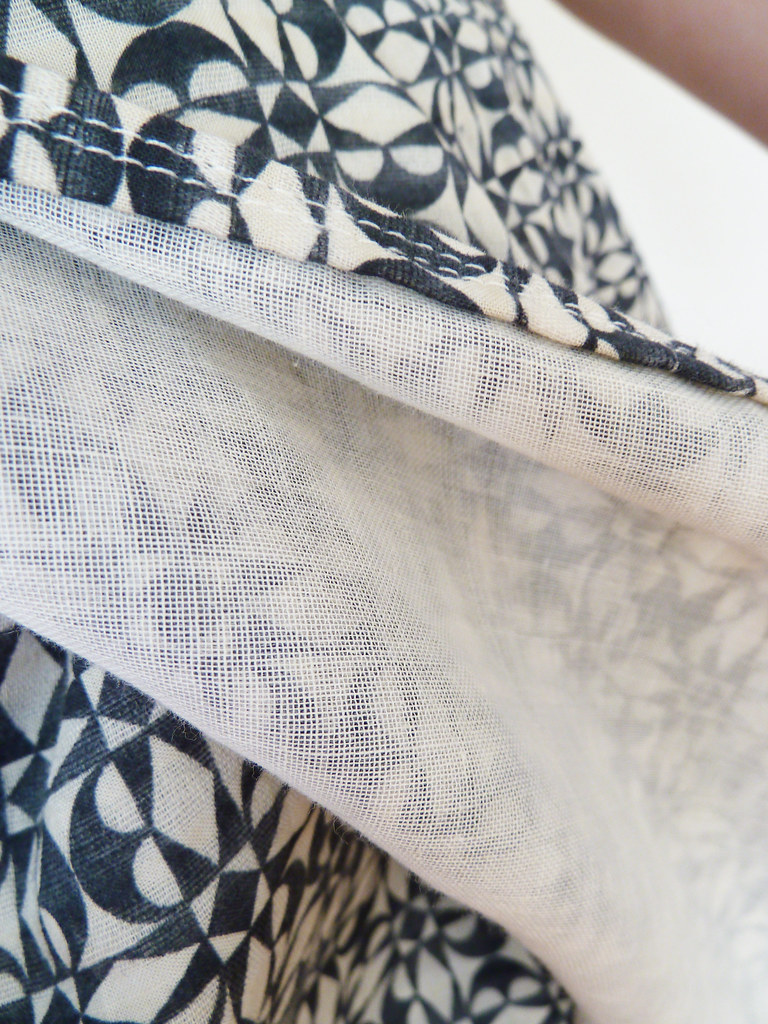
Day 1: So this dress was started just after I finished the last one, ostensibly as a "quick" project to wear a couple of days after starting it whilst it was still really hot (probably over a swimsuit), but for this "quick" project I decided to use a fabric that needed underlining and pattern matching. Um, yeah. Did I mention this was also the first time I'd underlined a dress? However, all that work was definitely worth it, with a couple of reservations, I'm pretty pleased with this dress.

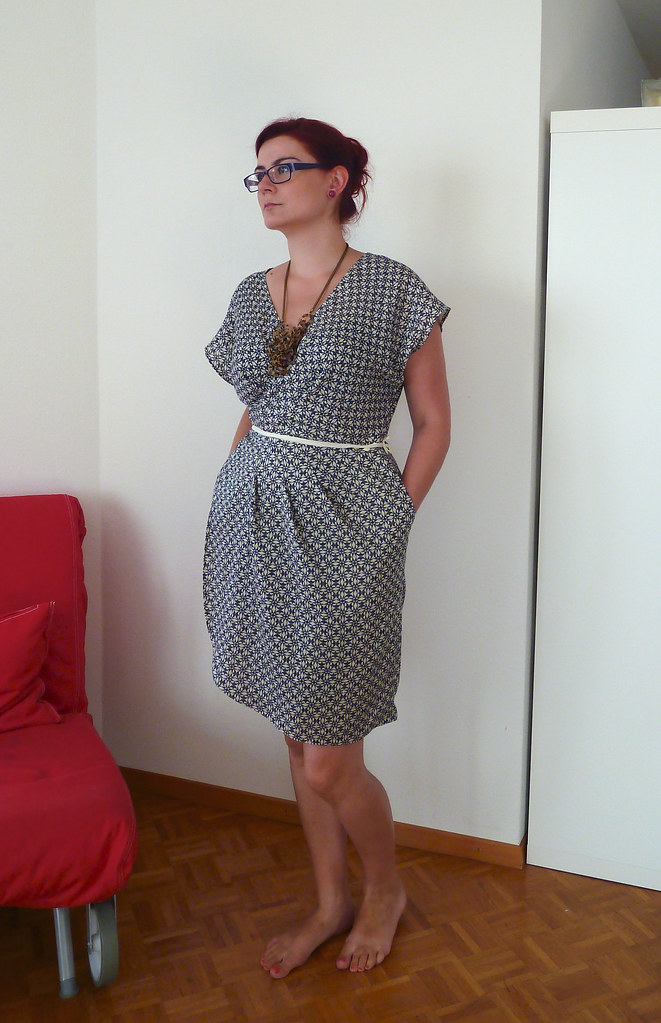
Dress: Me-Made / Necklace: Accessorise / Belt: eBay / Sandals: Office

Fabric used

A printed cotton lawn from Aberkhan Fabrics, and underlined with cotton batiste from Fabric.com.

Pattern alterations or any design changes you made

Again, I used ties on the outside wrap as well, but I'm not entirely happy with the look on this dress. Without the belt, it's a bit hospital gown chic... The wrap goes the opposite way to the pattern envelope again, as for some reason the pleats lie better that way again, and I left the pleats stitched as before to keep it from being too poofy over my midsection. I used the pockets this time, and I should have raised the armscye, but forgot.

Construction details

I cut the underlining from the pattern and put all the markings on that, then used the underlining to cut the fashion fabric. I used a rotary cutter to cut the fashion fabric as it was so flimsy. I loooove using the rotary cutter - I need to clear my "cutting" table to have more space to lay out fabric so I can use this more often. I then hand-basted the two layers together, again this was a first for me, and in my care to avoid stretching the edges I think I pulled the basting a little tight, but that wasn't a big deal.

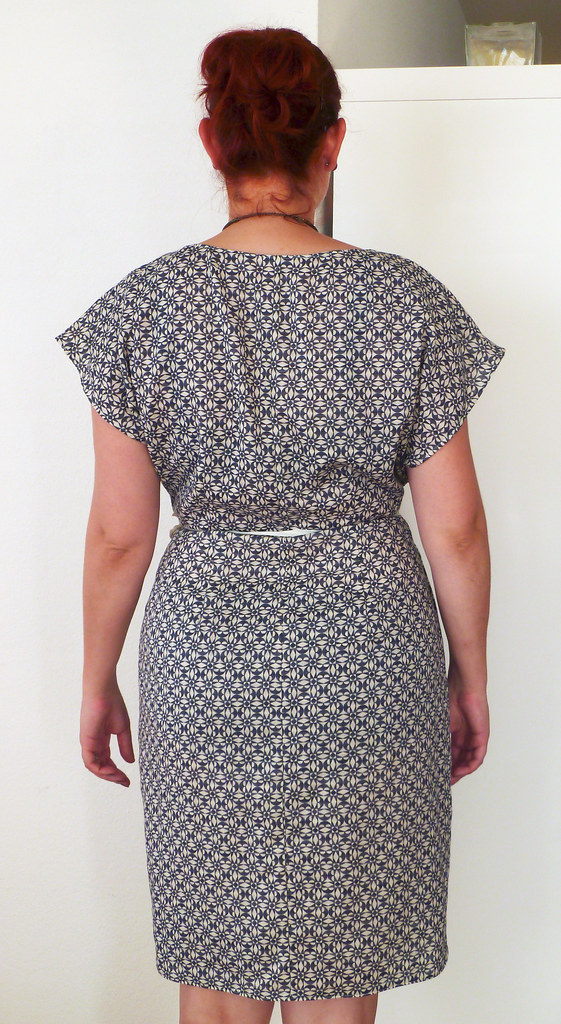
I used French seams for the centre back bodice and skirt, the shoulder and the waist seams, and regular seams finished with serged edges for the side seams. The edge was finished with a baby-hem (again, a little wide, hence the sleeves sticking out a little funny).

I'm pretty pleased with the pattern matching at the back - it wasn't so much of an issue at the front as both the front bodice and skirt are cut on the bias.

Would you sew it again? Would you recommend it to others?

I think I will leave this pattern for a little while (although I'm tempted to make it in a drapey knit). But it may reappear, once I work out how to make the the sleeves a little less linebacker.

Conclusion

I'm not entirely sure this doesn't look like a hospital gown, but with careful styling I think it's ok - that's why the ties are tied right around me in the photos, if they are tied at the side it really does look hospital chic. The fabric is still quite light so falls ok, although the charmeuse drapes better - anything much heavier I think would look a bit weird. I really really like the feel of the underlined fabric.