Showing posts with label reviews. Show all posts

Thursday, 28 May 2015

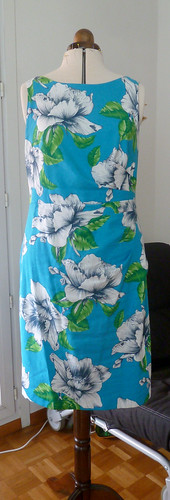
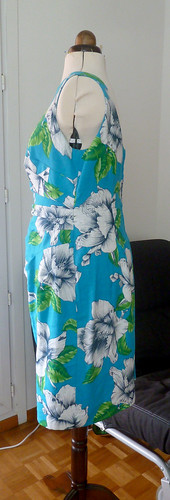
Lekala dress

I've been meaning to try Lekala patterns for several years, but for various reasons hadn't got around to actually doing it, mostly because the Russian-based site was pretty hard to work out, and the payment method was crazy complicated. I'd been seeing them crop up here and there recently though, and after realising they had an US-based English site too (with payment by PayPal), I thought I would give them a go.

If you haven't heard of them, their USP is that they supply patterns drafted to custom measurements - and they have many many styles to choose from (apparently there's even more choice on the original Russian website). Basically you simply enter your measurements, plus a few optional modifiers, and a PDF pattern is emailed to you a few minutes afterwards. They're also super super cheap (and even cheaper if you register or buy pattern bundles), and also royalty free, meaning you can sell what you make from them. Bootstrap Patterns license the software from Lekala but also have a few extra patterns that aren't on the Lekala site.

I bought a few patterns to try - this is actually the second one I made up. The first is pretty appalling - but that is not the fault of the pattern, but rather me picking a style that just wasn't terribly flattering...

Pattern description

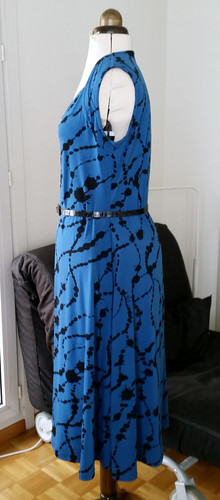
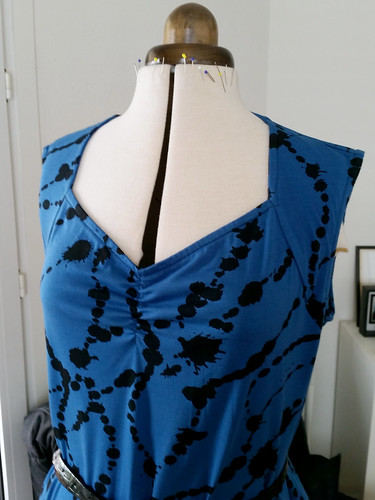
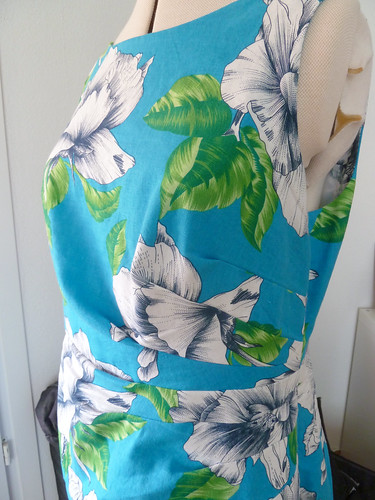
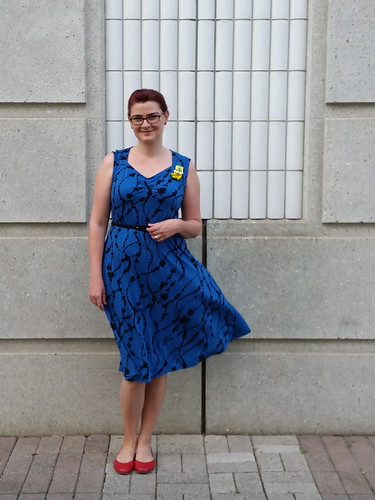
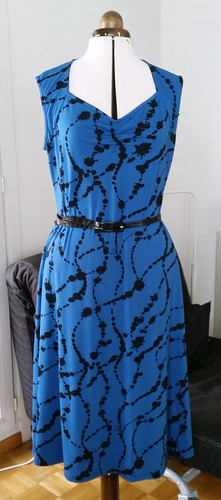
Lekala 4158: Knit top with front shoulder yokes and gathering at bust (lengthened into dress).
Fabric used

Rayon-lycra printed jersey.

Did it look like the photo/drawing on the pattern envelope/sketch when you were done?

Yes, but in dress form!

Were the instructions easy to follow?

The instructions were clearly written (this was one of their patterns that has been edited by a native English speaker), but they weren't particularly great as actual instructions, particularly in the methods used for finishing the armholes and neckline. One key bit of information that was missing was what length of elastic to use for the gathering at the centre front. I also thought I'd somehow managed to print it out too small as the seam allowances weren't 1cm as I thought was standard for Lekala, but actually 0.7cm (although the seam allowances were actually noted in the instructions).

What did you particularly like or dislike about the pattern?

Like: I love the shape of the front yokes and sweetheart neckline effect with the gathering, and especially love the custom fit.

Dislike: The instructions.

Pattern alterations or any design changes you made

Although Lekala patterns are drafted to your customised body measurements, there are of course limited numbers of measurements they use, so there will always be some adjustments needed. To test the fit, I made up a T-shirt version in cotton jersey with no adjustments except for adding a CB seam.

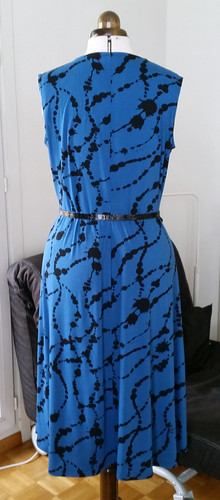
The first version fit perfectly on the front - for reference, I normally need to do an FBA around 2.5-3.5cm width and 2-3cm length on knits - although the back was a bit wonky, as I expected. This was an easy fix though - I did my usual adjustment of rotating the back shoulders and neckline down 2.5cm to shorten the back length above the waist, and shaped the CB seam at the waist.

To lengthen the top into a dress I simply extended the side seams into a cut-on A-line skirt shape. I went with a longer length than I normally wear as it seemed to suit this style, and I rather like it.

Construction details

As I mentioned above, there was no indication of how long to cut the elastic for the gathers at the front. I used my judgement and a piece 7.5cm long (plus extra at the ends obviously!). I used a little Fray Check on the bottom end of the elastic so it didn't shred too much (the top is enclosed in the binding).
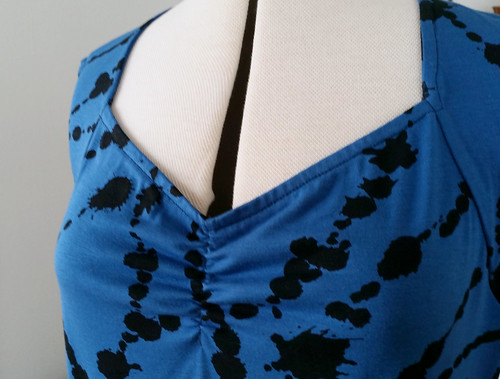
I finished the neckline and sleeves differently to instructed. Lekala would have you use bias tape for the lower front neckline, and just fold over and topstitch the rest of the neckline and armholes. I hate this method, so used self knit binding for all of these places.

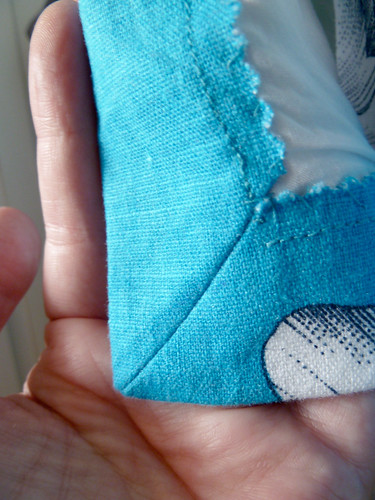
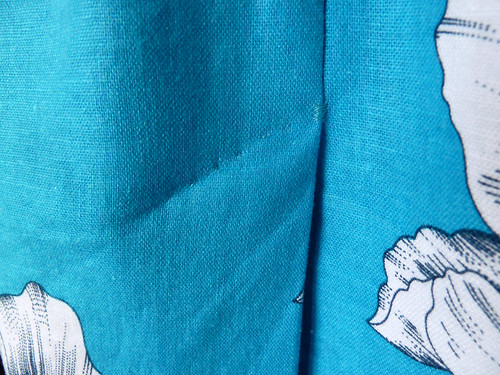
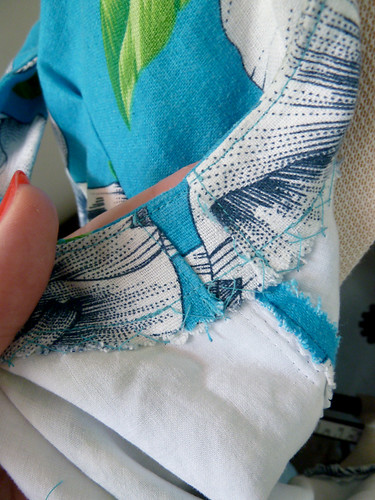
For the top, I sewed it as instructed, where the front yokes are sewn to the lower front, then shoulders sewn together and then the neckline finished. This is a little bit fiddly though when finishing the neckline at the corners where it joins the front, and also makes some weak points where you need to clip into the seam allowance at this corner. For the dress, I sewed the shoulder seams first, finished the neckline and armholes with topstitched binding, plus the lower neckline, stopping the topstitching a few centimetres before the join. I then sewed the front yokes to the lower front and finished the topstitching so that the corners of the visible stitching matched.. I also added a small piece of fusible interfacing at the intersection on the front yokes as the seam allowances still need to be clipped slightly.
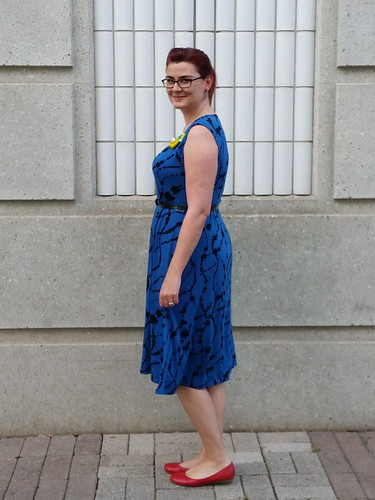
If I make this again I would leave the ends of the binding a little bit longer on the edges of the yokes and neckline so that these end up a little neater when they are sewn together (I cut them flush with the ends of the pieces, which means theres a little gap on the wrong side when they are folded in, which doesn't look so neat). The centre front could also probably do with a few stitches in the binding to keep the V shape neat. I would also probably use either a single layer on the binding strip, or sew the binding to the edge with the regular machine rather than the serger - as it is, with a narrow binding it gives a slightly bulky finish.

The seams are all serged, and the hem is serged at the edge to give it some stability, then simply turned up and topstitched.

To save fabric, I cut the the front and back with the print in opposite directions, but I don't think it's particularly noticeable (unless you're doing very intense CSI inspection of the direction of the paint splatter...). The two back halves look slightly different though, as I discovered after cutting (and sewing the CB seam) that there was a big fade mark on one half - near the hem I might have left it as is, but it would fall right under my bum so I'd look like I'd sat in something, so recutting it was! As it was a different area of the print it seems a bit different in intensity, but I'm not bothered by it (I rarely see my back).

Would you sew it again? Would you recommend it to others?

I might well sew this again, it's a flattering pattern and very quick to make. On this experience I would definitely recommend Lekala to others too. I can imagine at extremes of figure the software would struggle without a human influence to fine tune the drafting, and also the normal choices of what is likely to work on your figure still applies; however, for an investment of a couple of dollars (and they even have some free patterns to try) plus nominal printing costs, it's worth a go.

Conclusion

This has been a pretty good experience, although so far I've only tried knit patterns, but I have a woven blouse I want to try in the near future, plus many other choices lined up! I'm expecting I may need a couple of iterations with the measurements to get exactly the fit I want when I don't have the more forgiving fit of a knit fabric, and this is one of the drawbacks of the system - if you want the same pattern with different measurements, you need to buy it again. Once I have it down-pat though it should result in minimal fiddling.
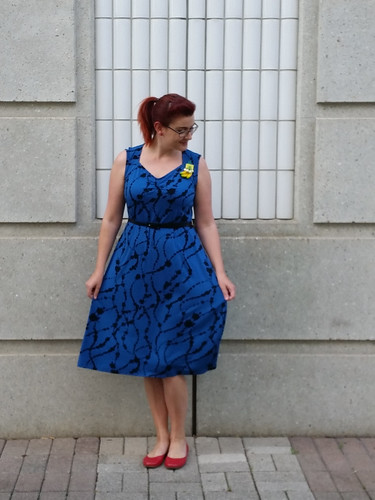
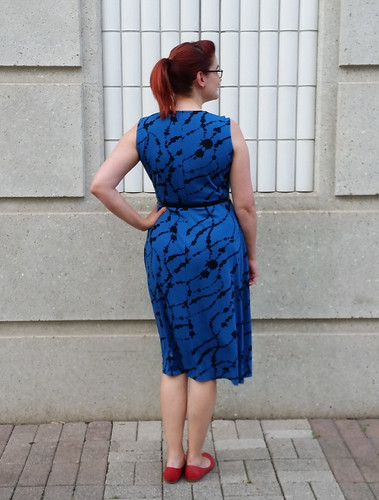
I like that it cuts out much of the bits of sewing I find boring - tracing patterns and making adjustments. It's even inspired me to work out how to use the Russian site as they seem to get the new patterns much more frequently (Melissa did a handy summary of how to order). The instructions really are quite bad (and I'm someone who thinks BurdaStyle instructions are fine), but I'm not buying the patterns for those, and have a reasonable grasp of construction and decent reference books, so for me that is not off-putting.

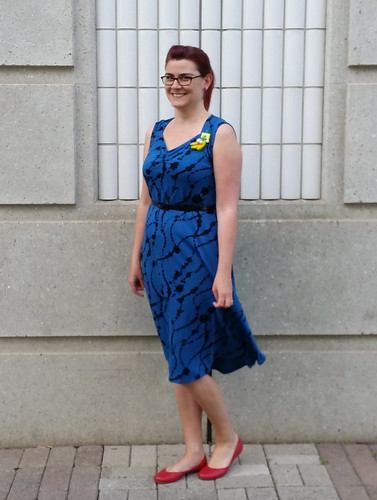
In terms of the dress itself, it's turned out very well, and is exactly the sort of thing I like wearing during the summer. I think next time I will also lower the bottom of the armholes a smidgen, and looking at the photos (which were taking on a particularly windy day...!) I need to adjust how it sits a little and remember to pull down the front enough when putting it on (the neckline is sitting a little high), but I really like this length on me - this pattern would even look nice lengthened into a maxi-dress.

Monday, 4 May 2015

Parisienne poodle cocoon coatigan

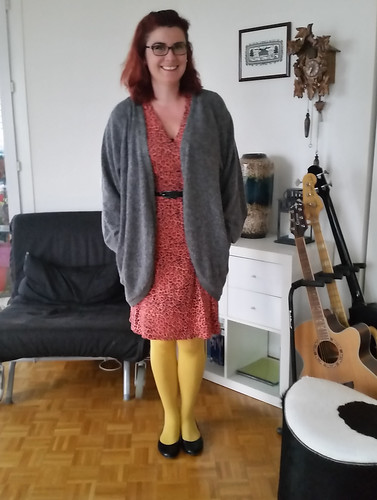
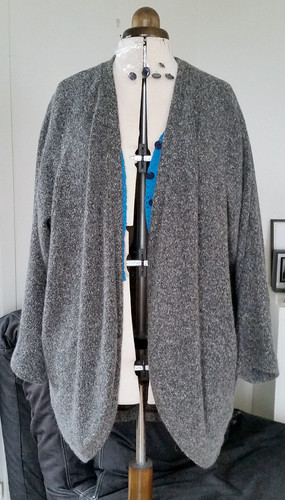
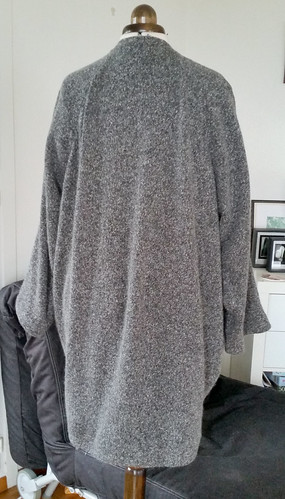
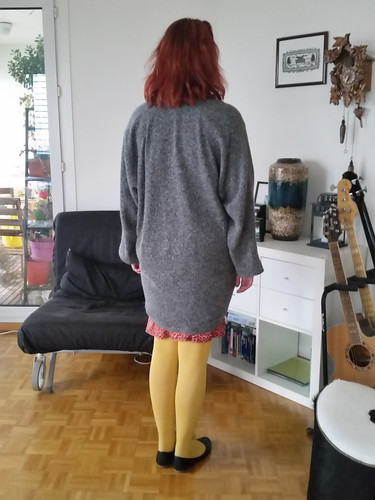
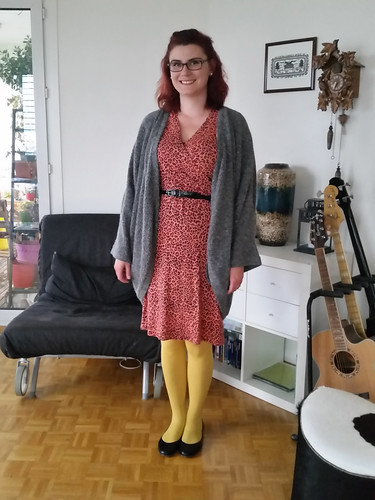
I love it when a plan works out...! This is fabric I bought back in March last year during my trip to Paris, and as soon as I saw it I knew exactly what pattern I wanted to make: BurdaStyle Magazine 2013/11/107. I've finally got around to making it, and it's pretty much exactly as I envisioned!

Pattern description

BurdaStyle Magazine 2013/11/107: Long-length cocoon-style jacket, with raglan sleeves, pockets and continuous hem band, and without fastenings.

Pattern sizing

36-44. I traced a 44.

Fabric used

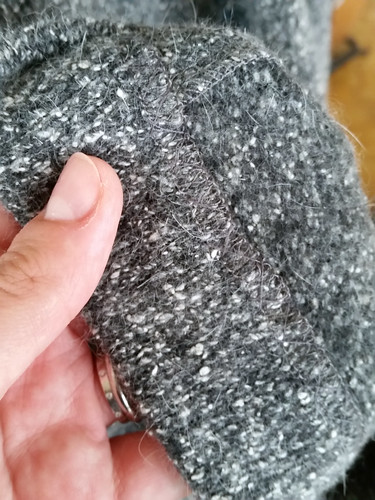
Mystery blend wool knit from Coupons de Saint-Pierre. It was marked as wool and definitely includes it, as it has that slight wet dog smell after washing and when using steam, but there's also probably poly in there, as it didn't shrink or felt with machine washing, and without a pressing cloth it was a little melty on the iron. It also sheds like crazy on dark colours, hence the title - after sewing it, I looked liked I'd been rolling around in pale dog hair... I'm hoping this will reduce a bit in time.

Did it look like the photo/drawing on the pattern envelope when you were done?

Yes!

Were the instructions easy to follow?

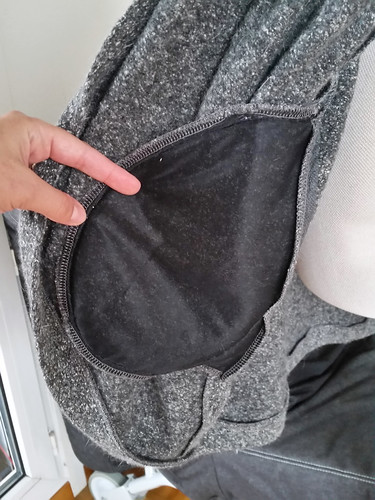
Mostly straightforward. I didn't really understand the directions for the pockets, but then I never do for Burda. I always do mine the usual way of sewing the pockets pieces separately to the front and back pieces, then sewing the side seams including the pockets.

What did you particularly like or dislike about the pattern?

Likes: I really love the cocoon shape - once again Burda were ahead of the game with on-trend styles (although of course us Europeans are terribly fashionable - my three-year-old winter coat is also a cocoon shape). I think it's a surprisingly flattering shape - I am a long way from the slim model they use, and according to the "rules" I should probably emphasise my waist, but I really like how I look in this shape. Plus no issue after a big meal. Or over a big jumper I suppose.

Dislikes: It would have been really useful to have some notches on the hem band in order to distribute it evenly. As it is, only CB at neck and hem are match points. The pocket openings are also a bit narrow and a bit low for me.

Pattern alterations or any design changes you made

Be warned - this jacket is really long. I knew from previous reviews that this was the case, so I shortened it 15cm so it fell between mid-thigh and knee (for reference I'm pretty tall, 178cm or 5'10" in old money) - I actually need to refine the shape of the front just a little bit more to soften the front curve at the bottom, and shorten the hem band slightly more to draw in the bottom of the back to more of a cocoon shape.

I also shortened the sleeves about 4cm. Apart from slightly enlarging the pockets I made no other changes.

Construction details

As I was using a fairly beefy but not super stable knit, I stabilised the seams with Vilene bias tape (love this stuff, buy it by the roll when I visit London). I also stabilised the front of the pocket openings with silk organza selvedge.

As the knit wasn't super stable I knew I'd also need to stabilise the pocket bags. I'd originally planned to use silk organza, and totally should have gone with this (or at least regular lining fabric). In the end I used a nylon tricot, but this is surprisingly heavy and bulky, and makes the pockets pull downwards a little weirdly. In order to try and counteract this, I pick stitched the top and bottom of the pocket to the jacket front, as well as the pocket opening. This supports the weight of the pocket a little so there's a bit less distortion, but is also fortunately pretty much invisible with this fabric.

Although I could have constructed it mostly on the serger, I actually serged the edges and then sewed nearly all the seams with my regular machine, with a straight stitch as stretch wasn't important in such an oversized garment.

The hem band is interfaced with the same nylon tricot used for the pocket interfacing (although here it was the perfect choice). I had originally contemplated sewing just one half of the hem band to the edge of the jacket, then folding the other seam allowance in and hand sewing that edge to the jacket so that the seam was fully enclosed. I'm not entirely sure why I didn't do this, possibly I thought it might be too bulky - in the end I attached it as directed (folded in half and serged), and it's not too bad. Maybe I'll pick stitch the seam allowance here too to keep it flat. The sleeve hems are catch stitched and invisible from both the outside and inside - I needed very good lighting whilst I was doing this bit!

Would you sew it again? Would you recommend it to others?

I might sew this again in a lighter weight knit for the summer, or even in a lightweight woven (there's a lovely version on the Russian BurdaStyle website in a bias cut yellow plaid...). It's a very quick make, and a fashionable and easy-to-wear shape too.

Conclusion

Despite being very pleased with this, I've managed to finally make it just in time for it to be too warm to wear it! I wore it on Friday night (when these photos were taken), but I think that's going to be the last time for a while... But it's a still a useful garment that means I'll have something to pull out when the weather does cool down again - I just need to work on a summer jacket now!

Wednesday, 17 September 2014

Tropical pleated dress

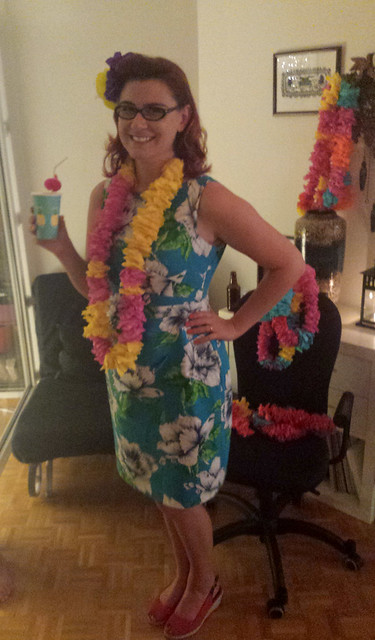
We needed an excuse to tidy our flat, so decided to throw a party! And of course that then gave me an excuse to make a party frock... Given the terrible summer we've had, we went for a tropical theme - so even more excuse for a party frock.

Pattern description

Simplicity 2053 - dress with pleated front bodice and skirt, choice of sleeves and length.

Pattern sizing

6-22 (Bust 30.5-44"). After looking at the finished measurements, I cut the 16 at the shoulders, 18 at the waist and 20 at the hips.

Fabric used

A linen blend (I think with cotton), underlined with rayon challis.

Did it look like the photo/drawing on the pattern envelope when you were done?

Sort of. I made some design changes to the neckline at front and back, but the main difference was the front skirt - I found it super difficult to get the pleats here to lie as nicely as they appeared on Simplicity's sample dresses.

Were the instructions easy to follow?

To be honest, I only looked at the instructions for the pleats on the front section (the waist seam on the front is sewn before the pleats are formed, then the side seams are sewn.

What did you particularly like or dislike about the pattern?

Like: the pleats on the bodice. The drafting of the pleats is generally nice (even if I did have to alter quite a bit to fit them to me).

Dislike: the pleats on the skirt. Also the huge amount of ease. The measurements give a whopping 3"/7cm of ease on the bust. Whilst that might be fine on a loose fitting and gently shaped garment, it's totally inappropriate here as a tighter fit is needed to keep the pleats in place. I think that's one reason the skirt pleats don't sit well since I kept the ease in the skirt to give myself some sitting space, but that allows the excess fabric to sag, rather than form nice neat pleats. Heh, neat pleats. The skirt pleats might also sit better in a slightly crisper fabric.

I also think it's madness putting the side zip in the side with all the pleats, as directed - it would be insanely difficult to get a neat insertion. I know the left side is the "proper" side for a dress zip, but if Simplicity desperately wanted to keep that, wouldn't it make sense to draft the pattern with the pleats on the right?

Pattern alterations or any design changes you made

I wanted a sleeveless dress, but with two straps (so I didn't have to wear a strapless bra), so I traced the bodice for the version with sleeves, but traced the armscye from the asymmetric sleeveless version onto both sides (mirrored obviously!). I also lowered the back neckline significantly to provide interest on the back and moved the zip to the centre back as I find these easier to get in and out of.

I pegged the skirt 6cm total, and increased the length of the back slit about an inch, as I felt it looked a bit stubby as drafted.

Hmm, the fitting was a little bit involved... Given the darts are all rotated into the pleats, I couldn't just do a standard FBA on the bodice - and I also didn't know how much the pleats would affect the fit. So... I made a muslin version of the unaltered pattern piece (unaltered for fit, it had my design changes), then figured out how much I needed to add in length and width by snipping into it and pinning extra fabric as required. Not the easiest thing to be doing to yourself, but I somehow managed not to chop up my bra or give myself any impromptu surgery...

Once I had my bodice fitting approximately how I wanted it, I unpicked the seams, laid it on my sewing table, and...

Yeah, it wasn't so easy to transfer the changes to the flat pattern - as I'd been doing the fitting on myself, it hadn't been possible to always cut and pin in a way that could be unfolded so I couldn't lay it out completely flat. After a little while staring blankly at the pattern piece, I went and had a cup of tea to contemplate what to do.

I decided to use the modified muslin piece as a guide for doing an FBA on the paper pattern piece. I could see how much length I'd needed to add at the bust point, and also how much width I'd needed to add on the plain (right-hand) side so did this as normal, adding a dart from the side seam (I wanted this as it would reduce the amount needed to add to the pleats and keep the dress closer fitting). For the left-hand side, I drew in approximate equivalent FBA lines (I'd marked bust points on the muslin), splitting the vertical length added between the pleats, and spreading the width the same as for the normal side.

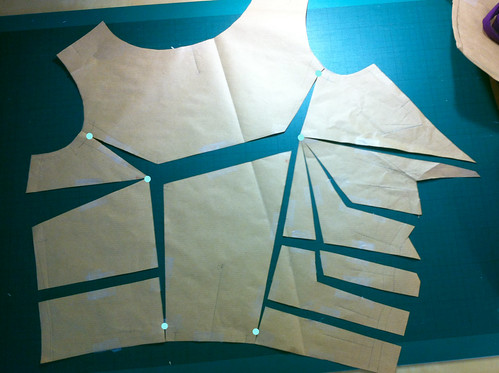
Here is the unaltered pattern piece with the slash lines marked. There is extra width at the waist on the pleat side as the paper was difficult to fold and true so I did this on the muslin. The pale blue lines are the pleat fold lines and the other colours mark the equivalent cuts in each side.

After spreading it, I got this. The blobs are the hinge points - note that I made this alteration on a pattern piece with seam allowances, so the hinge points are on the seam lines, not the edge of the pattern piece.

After cutting this new pattern from muslin, I arranged the pleats approximately on Wilma, then adjusted the fit on me. My bodged FBA actually worked quite well, although I needed to take out a little width on the pleat side.

Other than this, I shortened the back piece, and took a small wedge out of each side of the back neckline after lowering it to stop it gaping. The skirt only needed minor changes, and a slight rearrangement of the pleats. I also took out about 1.5cm of length in the bodice - this put the waistline seam at the perfect place in the muslin, but I must have done something weird as this turned out to be a problem in the final version.

Construction details

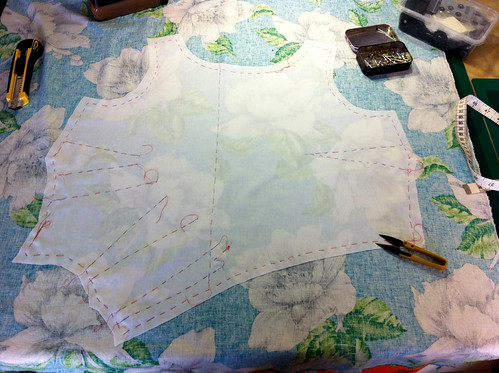
The linen blend fabric is fairly loosely woven and lightweight, so I chose to underline with rayon challis to provide some structure and opacity whilst keeping the softness and drape of the linen. A cotton batiste or lawn might have been a better choice as the rayon has the same tendency as the linen to "grow" slightly when worn (although that made for a super comfortable dress). I cut the underlining first and put the markings on this, then used these pieces to cut the linen, which meant I could be careful with the pattern placement. I started off hand basting the markings and the edge, but after spending ages doing this on the first piece I realised I'd moved the underlining slightly whilst straightening it so had moved from where I wanted the pattern placement to be. ARGH. After that I hand basted the markings but machine basted the edges (having learnt from the yellow dress to make sure to keep these within the seam allowances so I didn't have to pick everything out...)

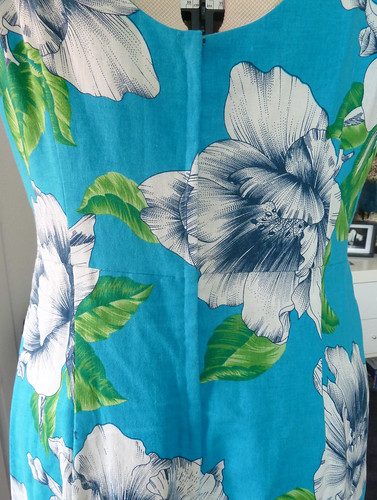
As for pattern placement, I managed to avoid bullseye flowers on boobs or butt! There's a bit of a crotch flower happening on the front skirt, but it's not so bad with all the pleats there. I also managed to match across the zip, and mostly match across the waistline seam.

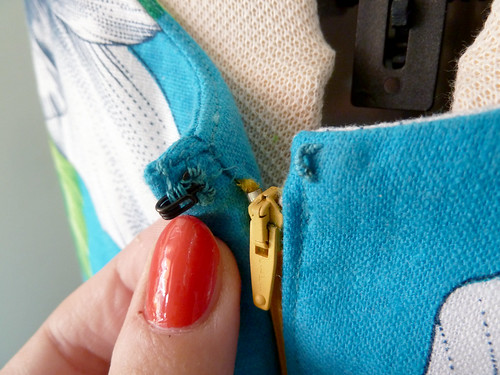
All the seams were sewn on the regular machine and then pinked to reduce bulk. These pinked seam allowances could do with being slip/catch stitched to the underlining, but I only did that along the CB zip and vent seams, and will come back to that for the rest of them. The zip was machine sewn on the underlap side and hand picked on the overlap side as I couldn't find a perfect thread colour match. I couldn't find a good colour match for the zip either so I went with a contrast zip (plus I'll go for the opportunity to use yellow wherever I can!). I finished it with a hook and thread loop at the top.

I went for a combined facing to finish the armscyes and neckline. Because the straps are quite narrow I didn't use the burrito machine method as I wouldn't be able to pull the dress through the straps. So I sewed the shoulders last and finished the facing shoulder seams by hand. The facing is under-stitched, and catch-stitched to the underlining.

I mitred the corner of the vent overlap and hem, and did the stitching along the top of the event by hand pick-stitches to avoid visible stitching again.

Unfortunately, I didn't try on the final dress until after basically finishing the whole thing and trimming the seam allowances, assuming the fit would be mostly similar to the muslin. Oops. The shoulder straps were too short, the waistline was waaaaay too high, meaning the fit of the skirt (especially at the back) was completely off), and the bodice was too tight on the upper half. ARGH AGAIN. I had a little cry, had another cup of tea, then took a deep breath and channelled Tim Gunn. I didn't want to waste the fabric, and the basic idea of the dress was fine, so I figured I'd try to make alterations.

To add some breathing space in the bodice I let it out at the side seams from underarm to about halfway to the waist, slightly more in the back than the front. This left me with teeny tiny seam allowances, hopefully they won't entirely disintegrate over time. I'd trimmed the seam allowances of the facing narrower than the bodice pieces, so I patched in a spare bit of fabric. Not super pretty, but it's on the inside.

Because of the way I'd finished and trimmed the shoulder seams, I couldn't let these out, so I lowered the front neckline about 1cm at the front. This meant trimming through some of my stay-stitching, fingers crossed the seam stitching and under-stitching here will prevent it from stretching too much. I also couldn't lengthen the bodice as the pleats go over the waist seam, plus the zip was already in, so I just pretended it was always meant to be slightly high-waisted/empire line, and adjusted the darts in the back skirt to shape it properly at the natural back waist. It's really annoying that these alterations meant the dress isn't as perfect as I wanted, but at least it was wearable!

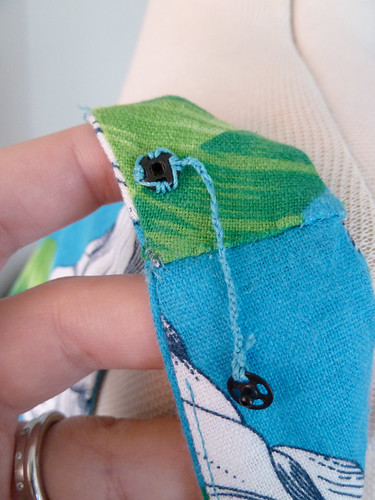
The slight tightness in the upper bodice meant that my bra straps showed a bit, so I also added thread chain lingerie holders, which worked well.

Would you sew it again? Would you recommend it to others?

I might use the bodice again (after adding back in the length...), but will either take out most of the pleats in the skirt or draft a new front piece. I would recommend it to others, but just pay attention to the printed final garment measurements when picking your size, and make a muslin to check the fit.

Conclusion

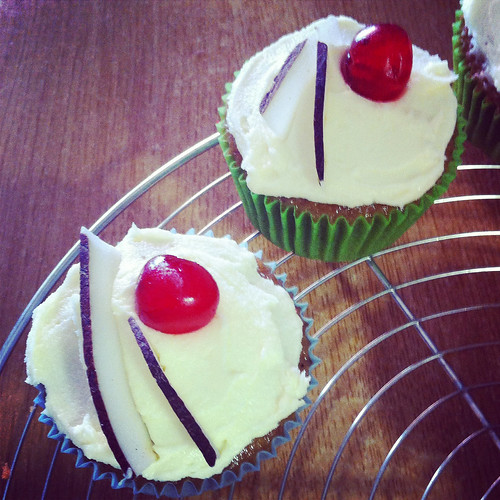
Despite the mess up with fitting, I wore this dress for the party and it was actually really comfortable - the fabric relaxed slightly during wearing, and is also super soft (the photos here were taken after wearing, hence a few wrinkles - I did iron it before taking the photos, but apparently not terribly well). I think I will take apart the front of the skirt and redo the pleats - either stitching them down more, or rotating some of them out, as it's pretty poochy across my belly as it is. The party, however, was super fun, there was lots of food and drink, and colourful decorations. Oh, and piña colada cupcakes...

Cheers! (Yes, that is a straw with a flamingo on it).

Friday, 29 August 2014

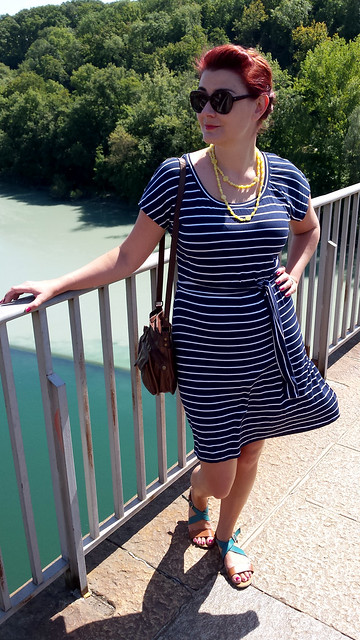
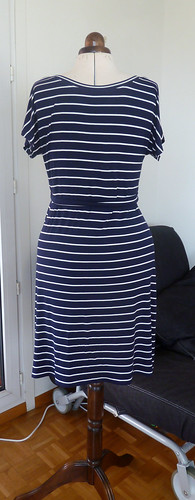
Stripy T-shirt dress

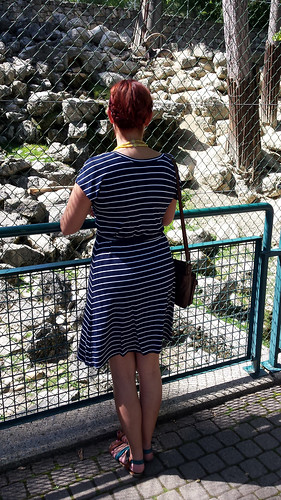
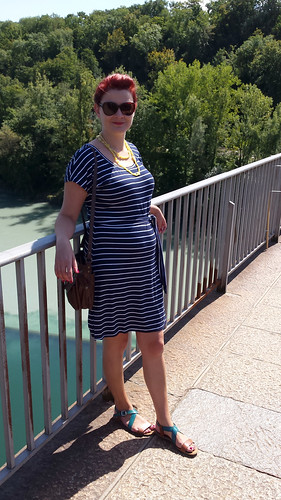
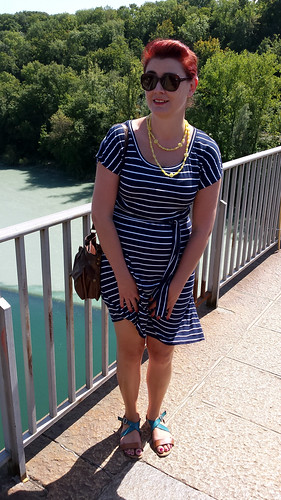
Well hello there strangers, long time no see... Isn't it scary how quickly the last couple of months have gone by? Or is that just me? I actually have quite a few finished makes to blog about, but I've not really been enjoying having my photo taken lately, and blog posts without photos aren't that exciting. However, I did get a few pictures of me in a very recent make during our Sunday afternoon stroll last weekend, so I'll start with that one!

Pattern description

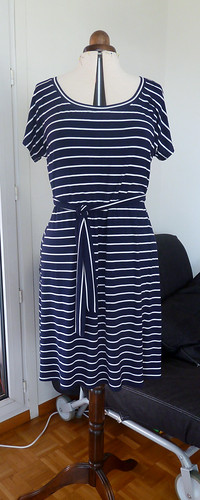
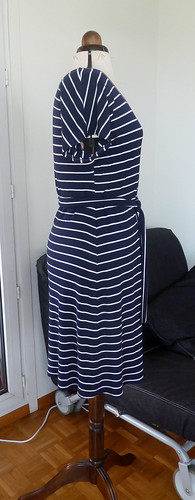
T-shirt dress with cut-on cap sleeves and A-line skirt.

Fabric used

Rayon-spandex knit from Fabric.com. This stuff is sooooo soft and not too lightweight, so this very much falls in the category of secret pyjamas!

Did it look like the sketch/idea when you were done?

I've been in need of a few basic-ish jersey dresses as my favourites are starting to wear out a bit. This turned out pretty much exactly how I hoped.

Drafting details

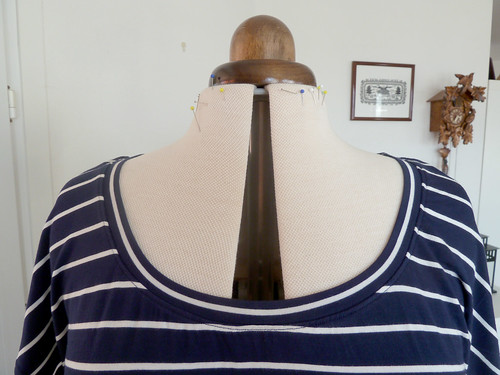
This is based on a cap-sleeve T-shirt I made a while back. I refined the fit by raising the front neckline and lowering the back neckline, taking in the back at the waist, and curving the shoulder/sleeve seam down after the shoulder point to narrow the sleeves. To make it into a dress, I simply extended the front and back pieces downwards and outwards from just above the waist line.

Construction details

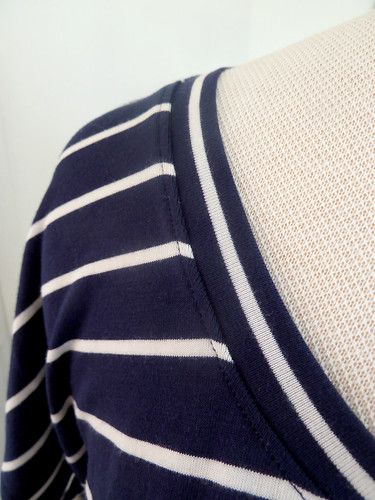
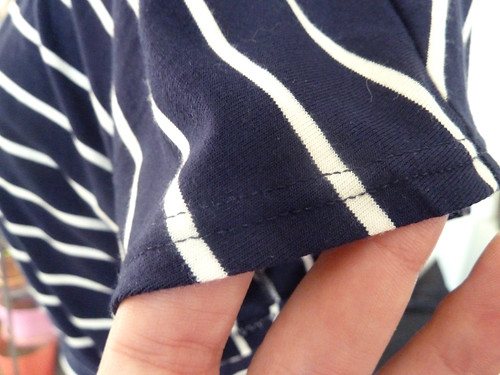
I stabilised the shoulders with fusible tape (for some reason straight grain not bias, so they're a little weird and stiff), and all the seams are sewn by serger. (I only had two cones of navy, so I used these in the left needle and lower looper so that any visible thread from the right side would blend in, using an off-white for the other two threads.)

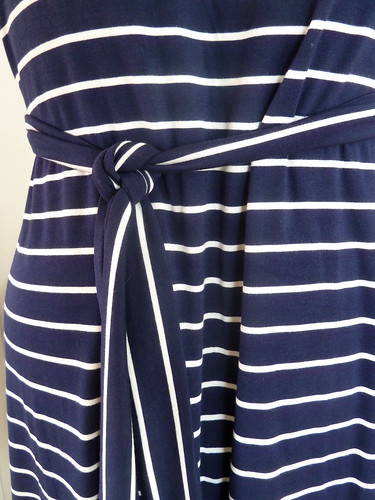
The neckline is my usual T-shirt type binding with topstitching, and the sleeve and skirt hems are finished with a twin needle. I've finally worked out how to stop tunnelling with the twin needle (at least on knits that aren't super lightweight) - take the tension reeeeeeaaaaaaally low. Like the other end of the tension dial low. The only problem with this is that the back doesn't look so neat, but I think this is a trade-off that I'll have to make, at least until I get my pressie of a coverstitch machine (hint, hint, Mr Dibulous...). The belt is simply a long thin rectangle with two sides sewn up, turned right side out, and the remaining short end slipstitched shut.

I did attempt to match the stripes at the side seams, although as I couldn't be faffed with basting the seams before sewing them on the serger, the matching isn't perfect, but is plenty good enough for this sort of quick make.

Would you sew it again?

Yep, I'm definitely going to be sewing up a couple more versions of this dress. I might add a bit more at the front waist and hip as it does cling a little to my belly (no, I'm not pregnant, that's just a food baby...), but other than that I'm pretty pleased with it.

Conclusion

This is a good "transitional" piece (ooh, get me, I sound like Anna Wintour) with the cap sleeves, and can be layered with tights or leggings now it's getting a bit cooler (not that it got particularly warm this summer...). A very handy dress that has already been worn many times since finishing it.

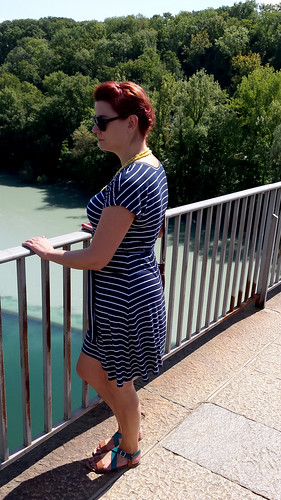
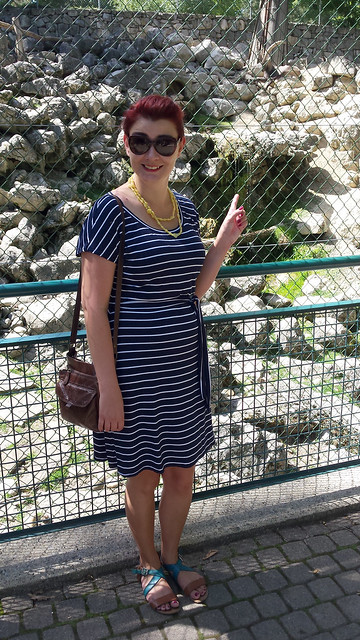
As a bit of an aside about the photos, the ones on the bridge show where the Rhône and the Arve rivers meet, and you can see the difference in colour (the Rhône is clear after travelling through Lac Léman, whereas the Arve is very silty). On a day when the rivers are a bit higher, you get cool swirling patterns as they mix. The stroll took us through the "zoo" near ours, hence the ibex in the other photos. Ibex!